
3.6. Effect of Different Solvent Parameters
The experimental NOE values of compounds 22 and 24 were measured in DMSO. All simulations of the test compounds were initially performed in \(\rm H_{2}O\) as this resembles a biological system most closely. To see the effect of solvent choice on the observed structures or relative populations, we performed various simulations of compound 22 with different DMSO parameters, and chloroform as a nonpolar solvent. Selected dPCA plots comparing these parameters are shown in Fig. 3.17 and Fig. 3.18.
Simulations in DMSO did not change agreement to experimental NOEs for compound 22 compared to \(\rm H_{2}O\). However, DMSO simulations seemed slower to converge, which is expected since DMSO has a lower dielectric constant than water, giving an overall slower electrostatic response. The similarity between \(\rm H_{2}O\) and DMSO is understandable since DMSO is also polar and capable of making H-bonds. The observed PES of the chloroform solvent looked qualitatively different. This is due to chloroform’s reduced ability to form H-bonds compared to the polar solvents. In terms of the NOE performance, we did not observe significant differences between solvents or solvent-parametrisations.
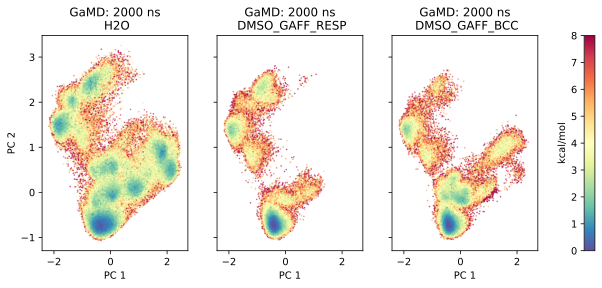
Fig. 3.17 Comparison of different DMSO parameters to a reference simulation in water. The DMSO simulations seem unconverged, but sample most of the observed structures in water.
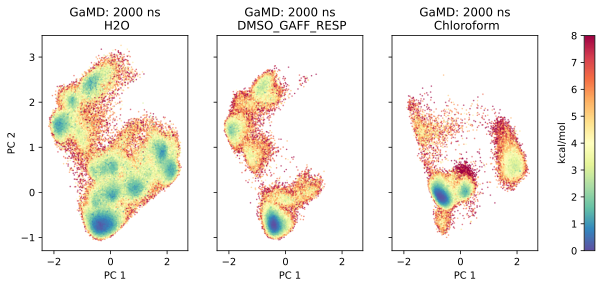
Fig. 3.18 Comparison of \(\rm H_{2}O\), DMSO, and Chloroform. Chloroform shows different relative populations with a different global minimum.